Every year around this time, the same conversation happens in Dubai. The utility bill lands, it is far larger than the last one, and nobody is entirely sure which part of it grew.
Two misunderstandings account for most of the confusion. The first is about how the tariff is calculated. The second is about which bill the cooling actually sits on.
Both are worth understanding properly, because they change what a household can usefully do about the number.
Clarvia does not provide financial, tax, or legal advice. The information below is general education only and may not apply to individual circumstances. Tariffs and fees are set by regulators and change; verify current rates and charges directly with DEWA, Dubai Municipality, or your district cooling provider.
The slab tariff is a ladder, not a cliff
DEWA charges residential electricity on a rising scale set out in Executive Council Resolution No. 16 of 2011, which came into force on 1 January 2011. The bands, by monthly consumption, are:
- 1 to 2,000 kWh: 23 fils per kWh
- 2,001 to 4,000 kWh: 28 fils per kWh
- 4,001 to 6,000 kWh: 32 fils per kWh
- Above 6,000 kWh: 38 fils per kWh
Here is the part that trips people up. Crossing into a higher band does not reprice everything you used. Each rate applies only to the units that fall inside its own band, in the same way an income tax bracket does.
A household using 3,000 kWh in a month pays 23 fils on the first 2,000 kWh and 28 fils only on the remaining 1,000. That is AED 460 plus AED 280, or AED 740 before surcharges and VAT. It is not 3,000 units priced at 28 fils, which would be AED 840.
The distinction matters because the "cliff" version of the story makes the bill feel arbitrary. Believing that one extra unit repriced an entire month leaves nothing useful to act on. Understanding that only the marginal units cost more makes it clear where a reduction actually lands: the top of the ladder, where each unit is most expensive.
These rates have been notably stable. DEWA's then managing director and chief executive Saeed Al Tayer told Khaleej Times in September 2022 that the price had not increased in the previous fifteen years, dating the structure to the slab system DEWA introduced in 2008.
Water follows the same tiered logic. The bands in the 2011 resolution were set per imperial gallon, at 3.5 fils up to 6,000 gallons, 4.0 fils from 6,001 to 12,000, and 4.6 fils above that. DEWA switched the billing unit to the cubic metre from the March 2025 billing cycle, so a current bill reads in cubic metres rather than gallons. Cubic-metre rates circulating on third-party calculator sites are arithmetic conversions of the older figures rather than separately published official rates, and can differ from what appears on a current bill.
The second bill many residents forget about
This is the larger of the two misunderstandings, and it explains a category of unexpected charge that has nothing to do with DEWA's rates.
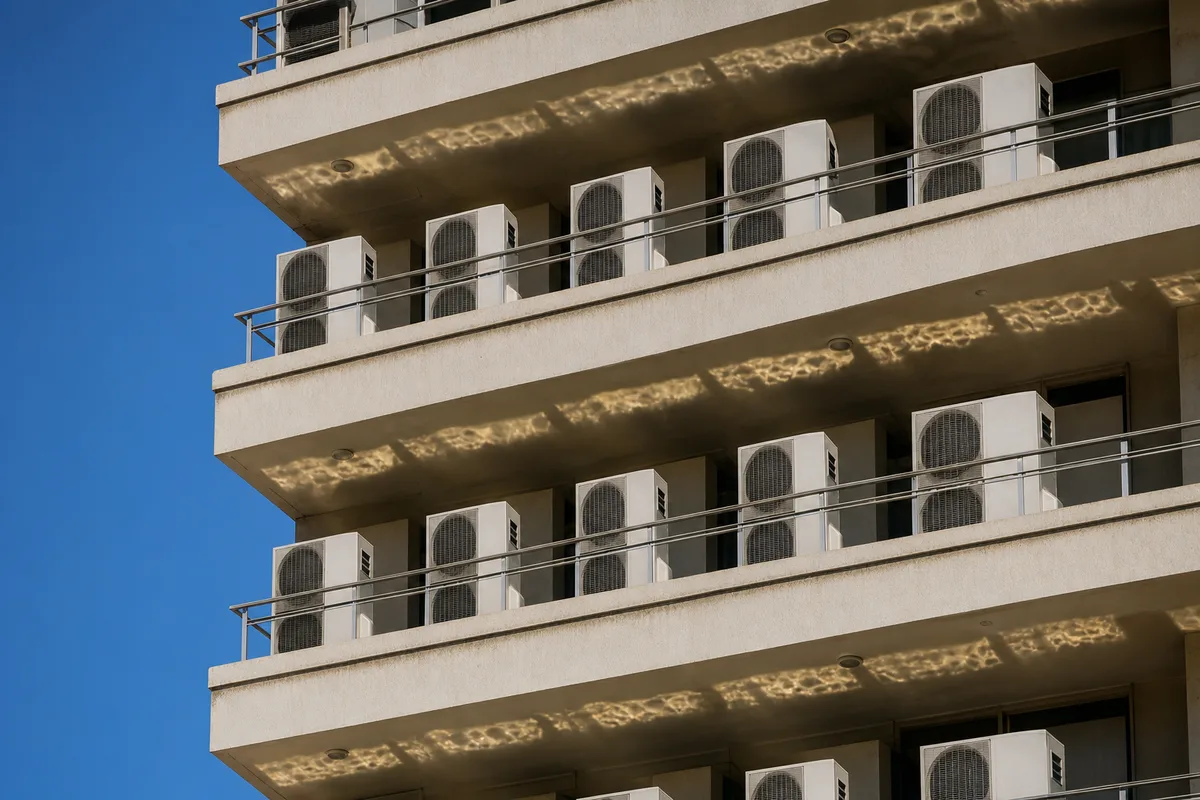
In buildings connected to a district cooling network, DEWA supplies electricity and water, but it does not supply the chilled water that cools the apartment. That comes from a separate plant operated by a district cooling company such as Empower or Tabreed, and it arrives as an entirely separate monthly invoice.
Residents in those buildings receive two utility bills. Looking only at the DEWA bill and concluding that cooling is inexpensive misses the invoice where much of the cooling cost actually sits.
District cooling bills are typically built from two components:
- A consumption charge, metered and billed in arrears, measured in refrigeration ton-hours, which is the cooling equivalent of a kWh. Empower's published consumption rate has been reported at around AED 0.568 per refrigeration ton-hour.
- A capacity charge, a fixed annual charge for the cooling capacity reserved for the unit, measured in refrigeration tons and reported at around AED 750 per ton per year. It is billed regardless of how much cooling is actually used.
That second component is the one most often queried, because reducing usage does not reduce it. The capacity provisioned for an apartment is generally set at construction by the developer rather than chosen by the resident. Mention of any operator here is for factual identification only and is not a recommendation, ranking, or endorsement by Clarvia.
Dubai's regulator has examined this directly and published its findings. The Regulatory and Supervisory Bureau's 2023 annual report, published in September 2024, records that developers have historically contracted more cooling capacity than needed, for fear of provisioning too little, and notes that where a building carries more contracted cooling than it uses, the result is lower operating efficiency and higher cost for occupants.
For a resident, that is useful context rather than a lever. It explains why a fixed cooling charge can look disproportionate to actual use, and why it is not something DEWA can adjust, since DEWA is not the billing party.
The lines that are not consumption at all
A meaningful share of a DEWA bill is not electricity or water. Several charges are collected through the bill without being consumption at all, which is why usage reductions bring the total down less than people expect.
The fuel surcharge is a separate per-unit line reflecting the cost of fuel used in generation and desalination. It is variable, reviewed periodically by the Dubai Supreme Council of Energy, and moves with fuel prices and Dubai's generation mix. The last clearly documented change reduced it with effect from 1 December 2020, taking electricity from 6.5 fils to 5 fils per kWh and water from 0.6 fils to 0.4 fils per gallon. Because it is adjusted periodically rather than fixed, a recent bill shows the current figure; published summaries lag behind it.
The housing fee is a Dubai Municipality charge, not a DEWA one. It is widely reported as 5% of the property's annual contractual rent, collected by DEWA on the municipality's behalf and spread across the monthly bills, paid by the tenant where a property is rented. It is tied to rent, not to usage, which means it does not move at all when consumption falls, and it does move when a tenancy is renewed at a higher rent. Residents sometimes read that increase as a DEWA rate rise.
A sewerage charge scales with metered water use, and a fixed meter service charge appears separately from consumption. Published third-party figures for both vary considerably; a current bill shows the applicable charge.
VAT at 5% has applied in the UAE since 1 January 2018 under Federal Decree-Law No. 8 of 2017. Its treatment is not uniform across every line on the bill, and the treatment of municipal fees differs from that of consumption charges, which is one reason the total does not scale neatly with the headline rate. The Federal Tax Authority and DEWA are the sources for how a specific line is treated.
There is no separate "conservation charge" on the bill. Dubai's Demand Side Management programme, launched in 2016 with a target of reducing electricity and water demand by 30% by 2030 and extended in 2024 to a further 50% reduction target by 2050, is a policy programme rather than a billed line. The slab tariff itself is the price-based mechanism: the more you use, the more each additional unit costs.
Why summer specifically
Air conditioning is the dominant driver of the seasonal swing. A specific share is harder to pin down than the internet suggests: the frequently repeated figure of 60% or more traces back to a statement by the then secretary general of the Dubai Supreme Council of Energy reported in 2012, and no recent official restatement of a precise percentage was readily available.
The mechanism matters more than the percentage. Cooling load rises through the summer months, consumption climbs, and because the tariff is tiered, the additional units are charged at the higher rates near the top of the ladder. A household that sits comfortably inside the first band in winter can spend the summer months buying its marginal units at 28 or 32 fils instead of 23. The bill rises faster than consumption does.
For buildings on district cooling, the same seasonal rise shows up on the second invoice instead, on top of a capacity charge that was already being paid through the winter.
What DEWA publishes to track it
DEWA publishes several tools for consumption visibility.
The DEWA Smart App handles account management and payment. The Smart Living service lets customers view consumption on daily, weekly and monthly views, explicitly framed around avoiding crossing into higher tariff bands, benchmark a household against comparable efficient homes nearby, receive monthly sustainability reports, and enable an Away Mode that sends consumption reports while travelling. A High Water Usage Alert flags unusual water consumption, which is often the first sign of a leak downstream of the meter.
DEWA has also repeated a specific thermostat recommendation of 24°C across public campaigns for years, from its 2018 summer saving campaign through to its 2025 summer campaign, which paired the digital tools above with personalised nudges and efficiency comparisons.
Where Clarvia helps
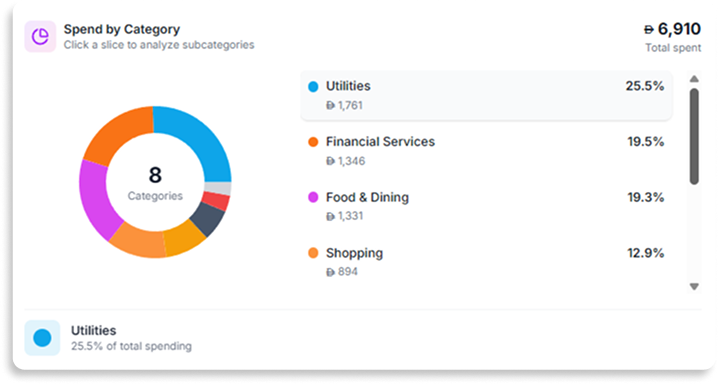
Utilities are a category where the total matters more than any single bill. The DEWA bill, a district cooling invoice, and any building service charges often leave the account on different dates, through different payment methods, under names that do not obviously belong together.
Upload bank statements and Clarvia categorises spending automatically, so utilities can be seen as a single annual figure and compared month against month. Because Clarvia separates recurring monthly costs from one-off and annual charges, a seasonal spike shows up as a seasonal spike rather than as a permanent change in the household's baseline.
If uploaded statements cover last summer, that period can be reviewed as the anchor for this one, which is generally more accurate than estimating the increase in advance.
Start your free trial to organise your UAE financial information in one place, and see what a full summer actually costs across both bills.