
For most expats in the UAE, sending money home is the single most repeated financial transaction of the year. Salary lands. Some of it goes to rent. Some to savings. And every month, almost mechanically, a chunk of it leaves the country and lands in another bank account in another currency.
The volume is large. UAE residents are estimated to have sent around AED 183 billion abroad in personal remittances in 2024, based on market data citing UAE Central Bank figures, up from approximately AED 169 billion the year before. A large share of that flowed to major expat destinations such as India, Pakistan and the Philippines. Reporting from Thunes and other industry sources points to growing digital adoption in regional remittances.
What that data does not show is how many of those transfers were unnecessarily expensive. Many senders may be paying more than they need to, especially when they compare only the headline fee and not the exchange-rate margin baked into the conversion.
This article does not recommend any specific provider. The right choice depends on the corridor, the amount, the day, the destination payout method, and the customer's tolerance for friction. What this article does is unpack the four main routes consumer remittances take out of the UAE, explain where the real cost actually sits, and point at a neutral benchmark for comparing typical costs on major corridors.
The four main routes
Most consumer remittances from the UAE fall into four broad channels. None is universally cheaper than the others. They are different products, with different trade-offs.
1. Bank wire transfer
The traditional route. You log into your UAE bank's app or visit a branch, send a SWIFT or correspondent-bank transfer, and the money typically arrives at the receiving bank within one to several working days, depending on the destination and any compliance checks.
Banks typically show the fixed fee clearly. The exchange-rate margin, the difference between the rate the bank quotes you and the underlying interbank rate, may be harder for customers to identify unless they compare it directly with the mid-market reference rate. Depending on the bank, corridor and amount, the all-in cost can be meaningfully higher than the visible fee once FX margins and any intermediary or recipient-bank charges are included.
2. Licensed UAE exchange house, in person
The visible route. Major UAE exchange houses such as Al Ansari Exchange, Lulu Exchange and Al Fardan operate under UAE Central Bank regulation, and many are represented through the Foreign Exchange and Remittance Group. Customers should verify a specific provider's current licence status before using it.
The in-person experience is fast, familiar, and works for senders who want a paper receipt and a person to talk to. Cash pickup at the destination is available in many corridors, which matters when the recipient does not have a bank account. Al Ansari Exchange, established in 1966, operates a large UAE branch network, which gives some sense of the scale of this channel. Pricing varies by corridor and by the specific house.
3. UAE exchange house digital app
The same providers, on a phone. Several large UAE exchange houses have invested in their app experiences over the past few years. In many cases the customer is dealing with the same regulated exchange-house group as in branch, though app pricing, limits, corridors and payout options can differ from the in-branch service. Some apps now offer fast or near-instant transfers to mobile wallets in the destination country. BOTIM has also added international transfer features through regulated financial-service partners; users should check the licensed entity actually handling the transfer.
4. Cross-border digital provider
Wise, Remitly, WorldRemit, Western Union digital, Payoneer and others. Built outside the UAE first, with global pricing models. Availability and licensing differ by provider; before using any cross-border digital provider, UAE customers should confirm whether the service is offered locally directly or through a UAE-licensed partner.
The pricing model also varies sharply between these providers. Wise, for example, says it uses the mid-market exchange rate (the rate banks use between themselves) and charges an upfront fee shown before confirmation; the exact fee varies by route, payment method, currency and transfer amount, so users should check the live quote. Other digital providers use different models, sometimes including an additional margin on the FX rate that is harder to see from the headline. Reading the fine print on any specific provider matters more than knowing the brand.
Where the cost actually sits: the FX margin
The most expensive part of a remittance is often not the headline fee. It is the difference between the mid-market exchange rate (the real rate banks use between themselves) and the rate the provider quotes you.
To make this concrete: if the underlying AED to INR rate on a given day is 22.85 and a provider offers you 22.40, the difference of 0.45 rupees per dirham is roughly a 2% margin baked into the conversion. On a 10,000 AED transfer that is 4,500 rupees of cost that did not appear as a fee on any screen.
This matters for three reasons:
- A provider that advertises "no fees" can still be more expensive than one with a visible fee, if its FX margin is wider.
- The fixed fee tends to dominate the cost on small transfers; the FX margin tends to dominate on large ones.
- The same provider can have very different effective costs on different corridors. Cheap to one country does not mean cheap to another.
A useful habit, where it fits a customer's needs, is to look up the mid-market rate on the day they intend to send. It can be checked on Google, on Wise's rate page, on XE, or on any major FX news source. Comparing a provider's quoted rate with that independent reference can help illustrate the exchange-rate component of the total cost.
A neutral benchmark for your corridor
Manually checking every provider on every transfer is unrealistic. The good news is there is a free, neutral benchmark that does much of the heavy lifting at the corridor level.
The World Bank runs a public portal called Remittance Prices Worldwide, updated quarterly, that tracks the cost of sending USD 200 and USD 500 across more than 360 country corridors, including all the major UAE outflows. The Q1 2025 dataset shows the global average cost of sending USD 200 was 6.49%, while the SmaRT average (the three cheapest qualifying services per corridor) was 3.29%. A UAE-to-X corridor sits somewhere in that range depending on destination, transfer size and provider mix.
For a real comparison on the day a transfer is going out:
- Look up the mid-market rate for the corridor (Google, XE, Wise rate page).
- Open the World Bank's RPW portal and check the typical SmaRT-average cost for the specific UAE-to-X corridor and amount.
- Get a live quote from two or three providers under consideration. Note both the visible fee and the offered FX rate.
- Calculate each provider's all-in cost: visible fee + (mid-market rate minus offered rate) × amount.
- Cross-check against the customer's own bank's quote for the same transfer.
The exercise takes about ten minutes the first time and a few minutes after that. For recurring transfers, even small differences in fee or rate can add up over the course of a year.
Common patterns worth knowing
Across UAE expat discussions over recent months, a few patterns repeat under almost every "what is the cheapest way" thread.
- The summary screen is not always the final price. With some digital providers, customers report a small additional margin appearing between the quote screen and the final pay screen. The check is to look at the actual amount the recipient will receive (in destination currency) on the final confirmation page and compare it back to the quote.
- Bank wires may be convenient and familiar, with deep integration into existing UAE banking apps. Their total cost is still worth comparing against other channels because pricing varies by bank, amount and corridor.
- Cash pickup can involve different pricing from account deposits. Where the recipient can receive into a bank account or mobile wallet, both delivery methods are usually worth comparing.
- Exchange rates can move over time, which means the recipient amount may vary between quote dates. This article does not recommend timing transfers based on currency movements; the appropriate transfer pattern depends on each sender's own needs and obligations.
- Fee structures may differ by amount. Providers apply fixed fees, tiered pricing, limits, or additional checks at certain thresholds. The provider's published terms for the specific transfer amount are the source of truth.
The harder problem: knowing what you actually have available
Even with a perfect provider choice, the deeper question for most UAE expats is not which app to open. It is understanding the monthly cash-flow context before making any remittance decision.
People earn in dirhams, plan in their home currency, and end up with a vague sense of "send what is left after rent" that is hard to defend or to optimise.
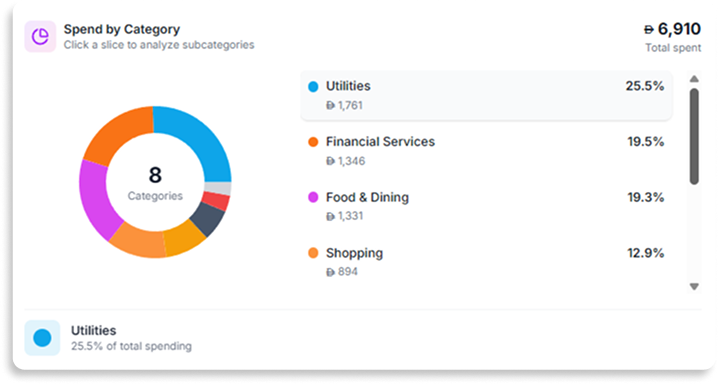
This is where Clarvia is useful. Upload salary statements and a UAE bank account, and Clarvia helps categorise income, expenses and past transfers so the customer can view their cash-flow history and recurring commitments in one place. That can make it easier to understand historical spending and transfer patterns before making any decision about how much, when, and through which channel to send.
Start your free trial to view your categorised spending and past transfer patterns in one place.