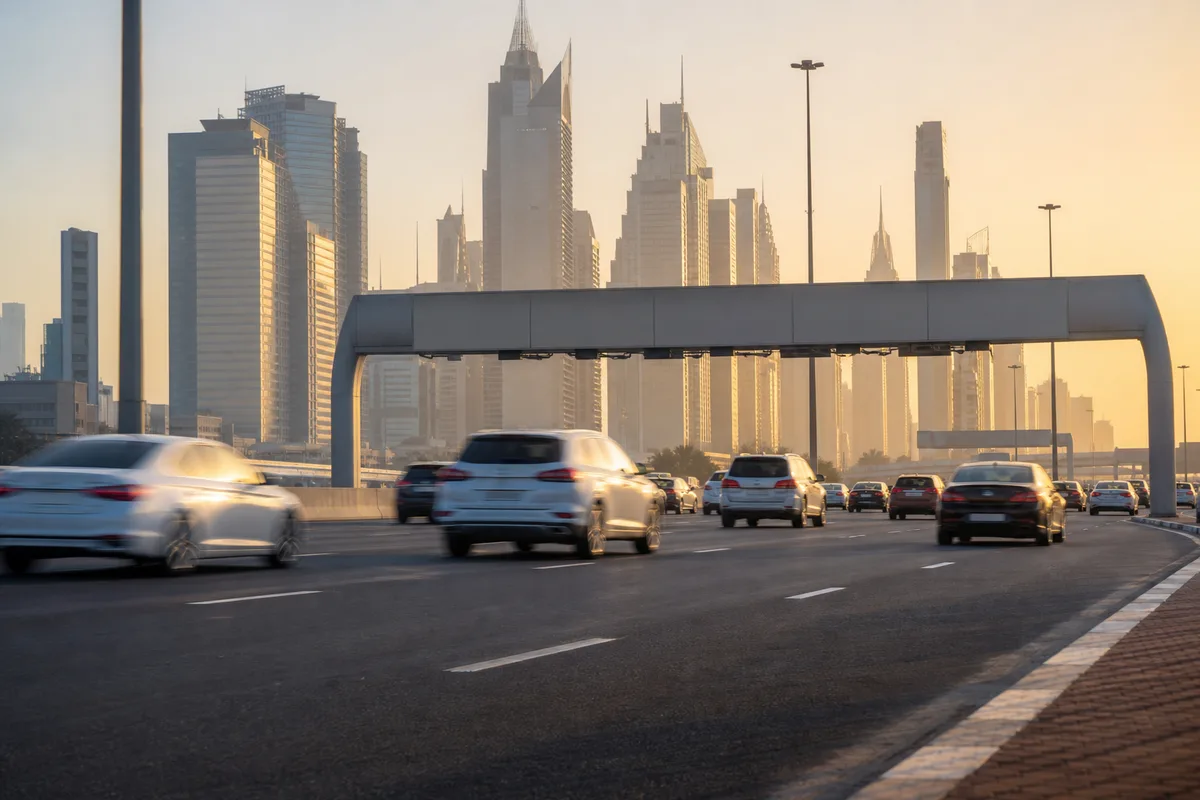
On 1 June 2026, two things happened to the cost of driving in Dubai on the same day. Salik began applying 5% VAT to its toll tariffs and tag activation fees. Parkin began applying 5% VAT to parking.
Both were widely reported, and both are real. Together they add roughly thirty fils to a peak toll crossing and twenty fils to an hour of standard parking.
Meanwhile, over the first five months of the same year, the price of a litre of Super 98 went from AED 2.53 to AED 3.95.
That is the larger part of the story of driving costs in Dubai in 2026, and it arrived one month at a time rather than as a single step.
Clarvia does not provide financial, insurance, tax, or legal advice. The information below is general education only and may not apply to individual circumstances. Fees, tariffs and penalties are set by regulators and change; verify current figures directly with RTA, Salik, Parkin, Dubai Police, or the relevant authority.
What changed on 1 June 2026
Salik Company PJSC announced that from 1 June 2026 it would apply 5% VAT to toll usage tariffs and to tag activation fees, collected on behalf of the Federal Tax Authority.
The underlying toll tariff did not change. VAT was added on top of it:
- A peak crossing moved from AED 6.00 to AED 6.30
- An off-peak crossing moved from AED 4.00 to AED 4.20
Parkin applied the same 5% on the same date, across on-street and off-street parking, seasonal cards, permits and reservations. A standard AED 4 hour became AED 4.20.
For a driver crossing four tolls a day, the Salik VAT works out to roughly AED 25 to AED 30 a month. It dominated coverage because it landed as a single dated change. The larger movements of 2026 were published too, but monthly and one at a time, which makes them easier to overlook.
The tariff sitting underneath the VAT
The 5% is calculated on a tariff structure that itself changed relatively recently, and that catches out drivers who still think of Salik as a flat AED 4 charge.
Since 31 January 2025, Salik has used time-of-day pricing. On Monday through Saturday:
- Peak, AED 6 before VAT: 6:00am to 10:00am, and 4:00pm to 8:00pm
- Off-peak, AED 4 before VAT: 10:00am to 4:00pm, and 8:00pm to 1:00am
- Free: 1:00am to 6:00am, every day of the week
Sunday runs at a flat AED 4 before VAT through the day, with one significant exception: the flat Sunday rate does not apply on public holidays or on RTA-designated special occasions, when the normal peak and off-peak schedule returns instead.
The number of gates has grown too. Dubai now has ten Salik gates. Two of them, Business Bay Crossing on Al Khail Road and Al Safa South on Sheikh Zayed Road, were activated together on 24 November 2024 following completion of the Al Khail Road Development Project. For anyone whose commute runs through Business Bay, that single change added a toll point to a route that previously had none.
The combination matters more than either piece alone. A commuter who leaves at 7:00am and returns at 5:00pm is paying peak in both directions, on a route that may now include more gates than it did eighteen months ago, plus VAT on top.
The number that moved most: fuel
UAE petrol and diesel prices are set monthly by the UAE Fuel Price Committee, which announces new prices on the last day of each month to take effect from the first of the next. The same prices apply at ADNOC, ENOC and Emarat stations across all seven emirates. The mechanism has worked this way since August 2015, when the UAE moved from fixed pricing to monthly adjustment tracking global benchmarks.
Reported Super 98 prices per litre tell the story on their own. The year opened at AED 2.53 in January and dipped slightly to AED 2.45 in February. March brought AED 2.59. Then April jumped to AED 3.39, May reached AED 3.66, and June hit AED 3.95.
That is a rise of roughly 56% in five months, with most of it arriving in a single step between March and April. The other grades moved in step, and diesel moved harder still, going from AED 2.72 in March to AED 4.69 in April, a jump of about 72%, before easing to AED 4.33 by June. Press coverage at the time attributed the April movement to disruption in global oil markets; the committee itself publishes prices rather than explanations.
The practical effect is easy to miss because it never arrives as a single event. A household filling a 60-litre tank four times a month paid roughly AED 607 for Super 98 in January and roughly AED 948 in June. That is an increase of around AED 340 a month, on a line most people never revisit after setting their budget in January.
The two changes are very different in size. Over the same period, the fuel line moved by an order of magnitude more than the toll VAT did. How much either matters depends on an individual household's mileage and vehicle.
Parking rose before VAT touched it
Parking followed a similar pattern, and the VAT again lands on top of a tariff that had already moved.
Dubai introduced peak and off-peak public parking pricing on 4 April 2025. Premium zones, covering high-demand areas including locations near metro stations and dense commercial districts, run at AED 6 per hour during peak windows of 8:00am to 10:00am and 4:00pm to 8:00pm, and AED 4 per hour off-peak. Parking remains free on Fridays and public holidays.
The aggregate effect is visible in Parkin's own published results. In its Q1 2026 results, released through the Dubai Government Media Office in May 2026, the weighted-average hourly public parking tariff was AED 3.02, against AED 2.00 in Q1 2025. That is a 51% year-on-year increase, before the June VAT addition. Premium parking accounted for 79,800 spaces at the end of the quarter, around 41% of a total public portfolio of 195,200 spaces.
A further tariff adjustment was requested by Parkin from the RTA in February 2026, which would require RTA review and referral to Dubai's Executive Council. As of early June 2026 no approval had been confirmed, so it remains pending rather than decided.
For a daily commuter parking in a premium zone, the year-on-year change in parking is a larger line item than the toll VAT by a wide margin.
The costs that do not arrive monthly
Fuel, tolls and parking are visible because they recur. The annual and occasional costs are the ones that tend to be forgotten between renewals.
Vehicle registration and testing. Registration renewal and technical inspection are annual for most private vehicles, and both carry the Dubai Knowledge Dirham and Innovation Dirham charges, AED 10 each, established under Dubai Law No. 1 of 2018 and Law No. 2 of 2018 respectively. Those two charges apply across most Dubai government service transactions above AED 50, with traffic fines and healthcare services exempted. RTA publishes the fee schedules for registration and inspection on its own channels; third-party guides frequently disagree with each other on the exact figures and on late-renewal penalties.
One avoidable cost is well documented: since 2 June 2025, pre-booking has been mandatory at most Dubai vehicle testing centres, and turning up without a booking at a centre that still accepts walk-ins carries an AED 100 surcharge.
Motor insurance. Insurance regulation moved to the Central Bank of the UAE under Decretal Federal Law No. 25 of 2020, which merged the former Insurance Authority into the CBUAE. The Unified Motor Vehicle Insurance Policy against third-party liability, originally issued under the Insurance Authority's Board Decision No. 25 of 2016, now sits within the CBUAE rulebook, and includes minimum tariff provisions. The CBUAE subsequently instructed insurers not to sell motor policies below those minimum limits.
Reproduced versions of the tariff table put the minimum third-party premium for a private four-cylinder saloon at around AED 750 before VAT, which is higher than some marketplace advertising suggests. Prices sitting below that reproduced floor may reflect a different scope of cover, a different vehicle class, or an out-of-date tariff table. What level of cover suits a particular vehicle, driver and usage pattern is a question for a licensed insurance broker rather than an article. Mention of any provider or scheme here is for factual identification only and is not a recommendation or endorsement by Clarvia.
Fines. Traffic fines in Dubai span a wide range depending on the violation, and accumulate black points alongside the monetary penalty, with licence suspension following at 24 points within a twelve-month period. Dubai Police publishes current fine amounts, point values and any early-payment or seasonal discount schemes, all of which change periodically; secondary summaries are often out of date.
Published estimates of total annual running costs for a car in Dubai commonly land somewhere between AED 15,000 and AED 50,000 depending on the vehicle, but these come from car marketplaces and comparison sites rather than from any official source, and most were compiled before the 2026 fuel movement. They are useful for orientation and poor for planning.
Why a Dubai driving budget drifts through the year
The pattern across every category above is the same. The one-off changes are small and easy to see. The larger movements are published on a rolling schedule and arrive gradually.
A driving budget built on figures from the start of a year will be wrong by the middle of it, not because of any single decision, but because fuel resets monthly, tolls vary by the hour of travel, parking varies by zone and time, and the annual costs land in months that are easy to forget. Reviewing a full year of actual spending is one way to see the real figure, and it avoids the compounding error of estimating each line separately.
Where Clarvia helps
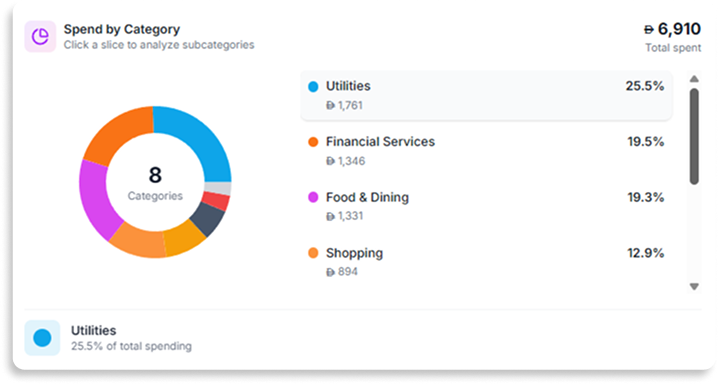
Motoring costs are unusually fragmented. Fuel goes on one card, Salik tops up automatically, parking is charged through an app, insurance and registration land once a year, and fines arrive whenever they arrive.
Upload bank statements and Clarvia categorises spending automatically, grouping fuel, tolls, parking, insurance and vehicle fees so the true monthly cost of a car is visible as one figure rather than a dozen small ones. Because annual charges are separated from recurring monthly costs, a registration renewal or insurance premium does not distort the month it lands in.
If uploaded statements cover the start of 2026, the fuel line can be compared month by month against the price changes above, which is usually a faster way to see the effect than recalculating it.
Start your free trial to organise your UAE financial information in one place, and see what your car actually costs across a full year.