
For UAE residents, Ramadan changes two things at the same time: the working calendar and the spending calendar. Working hours shrink by mandate. Grocery bills go up. Iftar invitations multiply. Eid Al Fitr lands a few weeks later with its own line-items in the form of gifts, travel, and time off.
For Muslim residents, the rhythm is familiar and the spiritual centre of the year. For non-Muslim expats, especially those who arrived in the UAE recently, it can be the first time the cultural calendar shows up directly on the bank statement. Either way, planning for it as a recurring annual event tends to be much easier than absorbing it month-by-month as it happens.
This article is a practical, secular guide to the financial mechanics of Ramadan and Eid Al Fitr in the UAE. It is not religious guidance, and it is not financial advice. The aim is simply to make the predictable parts of the next four weeks easier to plan around.
Ramadan working hours: official announcements to check
The UAE Ministry of Human Resources and Emiratisation has confirmed that during Ramadan 2026, normal working hours for private-sector employees are reduced by two hours per day. For an eight-hour standard day, that is six hours of working time during the holy month.
Two important features of that announcement:
- The reduction applies to all private-sector employees, regardless of religion or fasting status.
- Companies have discretion to adopt flexible or remote work during Ramadan, provided the reduced daily hours are observed.
For federal-government employees, working hours have been published as Monday to Thursday from 9:00 to 14:30, and Friday from 9:00 to 12:00, per the 2026 schedule. Overtime treatment may depend on your contract, role, employer, and the specific UAE labour rules that apply. If Ramadan hours affect your pay, the position is worth confirming with HR or against the current official MoHRE guidance.
For hourly, shift-based, or commission-linked workers, Ramadan schedules may affect cash flow. It is worth confirming with the employer how pay is handled during the reduced-hours period, particularly for employees on contracts that are not standard salaried structures.
Ramadan 2026 is expected to begin on Thursday 19 February, subject to the official moon sighting, and to end around 20 March. Eid Al Fitr public holidays follow immediately and typically run for three to four days.
Where the extra spend actually shows up
Industry research, drawn from supermarket and consumer-survey data, points to a few consistent shifts in UAE household spending during Ramadan.
The big one is food. Industry analysis shared by Khaleej Times suggests that food bills can jump by 50% to 100% during the month, that Ramadan accounts for around 15% of total yearly food expenditure, and that 83% of UAE families change their food consumption habits during the period. Bread, chicken, and dried fruits are particularly seasonal: consumption typically rises by 63%, 66.5% and 25% respectively versus the rest of the year.
A YouGov-cited Aletihad report adds that 57% of UAE residents report increased grocery spending during Ramadan, and that delivery and dining-out spend rises alongside the grocery shift.
The structural reasons are familiar to anyone who has lived through a few Ramadans in the UAE: Iftar at home tends to involve a wider table than a normal weekday dinner, dates and traditional sweets become daily items, and hosting friends or family for at least one or two Iftar evenings is common.
Costs in other categories tend to follow predictable seasonal patterns:
- Eid Al Fitr gifts. New clothes for children, gifts for family members, and Eidiya (cash gifts traditionally given to children by older relatives) all land in the days around Eid.
- Travel. Eid Al Fitr is one of the two peak travel windows of the UAE calendar. Flights, hotels, and short-haul travel within the GCC tend to be priced accordingly. Booking earlier or being flexible on dates is usually the lever.
- Charitable giving. Many Muslim residents choose to calculate or pay Zakat during Ramadan. It is commonly described as 2.5% of certain qualifying wealth held over a lunar year, but eligibility and calculation are religious matters and individuals should consult a qualified source if unsure. For non-Muslim expats, charitable giving is also common during the month and is supported by licensed UAE charities and official giving campaigns. Donating through approved channels and verifying the organisation is the standard recommendation from UAE authorities.
How retailers respond
UAE supermarkets and online platforms run their largest annual promotional cycles around Ramadan. Major UAE supermarkets and online grocery platforms typically publish Ramadan promotions, including discounts on staple items and weekly flyers covering essentials. Coverage from Gulf News on retailer plans for 2026 noted that the typical pattern for the larger chains includes price freezes on a curated list of staple items alongside broader promotional discounts.
For a household trying to keep grocery spend manageable, the practical takeaway is that the major chains are competing actively for the Ramadan shop. Comparing the weekly Ramadan flyers, where each major retailer publishes essentially the same staples at different price points, can help keep the food line of the budget closer to its normal range.
UAE general consumer-price inflation has remained contained, at around 2.17% in late 2025 with forecasts in the 1.8% range for 2026, and food inflation specifically was around 1% year-on-year in late 2025 according to Trading Economics. The seasonal Ramadan pattern is real, but it is happening on a relatively flat overall price backdrop.
How non-Muslim expats can prepare
For expats who are not fasting, a short list of things worth knowing in advance:
- Eating, drinking and smoking in public during fasting hours is the subject of local rules and norms that vary by venue and emirate. Practices have evolved in recent years, and many cafés and restaurants now operate with curtained sections during the day, but discretion remains the norm. The current official guidance is the source for the year's specific position.
- Office hours, school timetables, and gym schedules all shift. Some gyms reduce daytime classes and add evening slots after Iftar. Schools typically end earlier in the day. It is worth checking each one rather than assuming the previous month's schedule still applies.
- Restaurant bookings for Iftar at popular hotels and standalone Iftar tents fill quickly, especially for the first and last weekends of the month. Booking early is the norm.
- Public transport, parking, and roads see meaningful shifts in load patterns, particularly in the half-hour before Iftar. Some UAE residents adjust school pick-ups, gym sessions, and supermarket runs to avoid that window.
- Cash for Eid Al Fitr. Eidiya is traditionally given as crisp, fresh notes. UAE banks see queues for fresh AED notes in the days before Eid; ordering in advance through bank apps or visiting earlier in the week tends to be easier than the day-before scramble.
For many non-Muslim expats, joining colleagues, friends, or neighbours for an Iftar can be a common way to experience the month respectfully. The UAE's character during the month is more visible than at any other time of year.
A simple Ramadan and Eid budget shape
A useful exercise, around two weeks before Ramadan begins, is to sketch out a one-page Ramadan and Eid budget overlay on top of the normal monthly budget. The aim is not to set rules; it is to surface the items that are predictable so that they do not arrive as surprises.
A typical overlay touches on:
- The grocery line for the four weeks of Ramadan, anchored against the previous year's actual figure if it is available
- Iftar and dining-out for the planned hosting and visiting
- Charity and community giving, sized by personal preference and history
- Eid clothes and gifts, including Eidiya cash if relevant
- Eid Al Fitr travel, if planned
- An expected income adjustment for hourly or commission-based earners
Looking at the overlay alongside the rest of the household budget makes it easier to see whether the total works on the existing income, or whether a temporary trim in another category, an additional savings draw, or a cash-flow shift is appropriate.
Where Clarvia helps
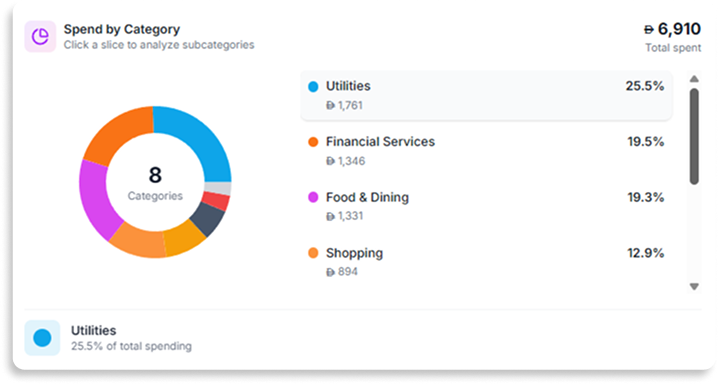
Clarvia is built to make the predictable parts of UAE expat finance visible without manual effort. Upload bank statements and payslips, and Clarvia categorises spending automatically, separates one-off events like Eid travel or annual school-fee instalments from recurring monthly costs, and lets you compare any month to its equivalent last year.
If uploaded statements cover last Ramadan, that historical data can be reviewed as the anchor for this year's plan. Charity, gifting, and travel all show up in the same view once categorised, so the overlay above can be built on real numbers rather than guessed ones.
Start your free trial to organise your UAE financial information in one place; if your statements cover last Ramadan, you can use that period as a starting point for planning this year.