
Search for the minimum health cover a UAE resident needs and one number comes back again and again: AED 150,000. It appears on broker sites, comparison pages and summary articles, usually presented as the national floor.
It is a real figure, and it is correct in exactly one emirate.
The UAE does not have a single national health insurance law. It has three parallel regimes, each with its own regulator, its own rulebook, and its own minimum benefit level. Since January 2025 every resident across all seven emirates must be covered, which has made the differences between those regimes matter far more than they used to.
Clarvia does not provide insurance, medical, legal, or tax advice. The information below is general education only and may not apply to individual circumstances. Minimums, premiums, and penalties are set by regulators and change; verify current requirements directly with DHA, DoH, MOHAP, MOHRE, or ICP, or with a licensed insurance broker.
Three regulators, not one national rulebook
Which rules apply to a resident depends on which authority governs the emirate their residency permit sits under.
Dubai is governed by the Dubai Health Authority, under a 2013 health insurance law in effect since the start of 2014.
Abu Dhabi is governed by the Department of Health, formerly HAAD, under a 2005 law effective from June 2006. Abu Dhabi has therefore had mandatory cover for close to two decades, longer than anywhere else in the country.
Sharjah, Ajman, Umm Al Quwain, Ras Al Khaimah and Fujairah had no general resident-wide mandate at all until recently. That changed on 1 January 2025, when a federal scheme extended mandatory cover to private-sector employees and domestic workers in those five emirates. It is administered through the Workers Health Insurance product, delivered under the supervision of the Ministry of Human Resources and Emiratisation in collaboration with ICP and the Ministry of Health and Prevention.
The practical consequence is that a resident who moves from Ajman to Abu Dhabi, or who takes a Dubai job while living in Sharjah, is not simply changing address. They may be moving between rulebooks.
The AED 150,000 figure is a Dubai number
Here is where the widely repeated national figure breaks down. The confirmed minimum annual benefit level differs substantially across the three regimes:
- Dubai, under the Essential Benefits Plan, sets an annual aggregate claims limit of AED 150,000. This is the source of the number that circulates as though it were national.
- Abu Dhabi, under its Basic Health Insurance Plan delivered through the national insurer Daman, sets an annual limit of AED 250,000, confirmed by the Abu Dhabi Government Media Office in May 2024 and effective from 1 July 2024. This is higher than Dubai's floor.
- The Northern Emirates Workers Health Insurance Basic Plan provides AED 50,000 for inpatient care and AED 10,000 for outpatient care, roughly AED 60,000 combined. An Enhanced tier provides AED 100,000. Both sit below the Dubai figure.
The spread between the highest confirmed minimum and the lowest is therefore around fourfold. A resident who assumes AED 150,000 applies to them because they read it online may be significantly over-estimating or under-estimating what their mandatory policy actually pays out.
The published premiums for the Northern Emirates scheme are similarly modest. The scheme's own materials list AED 320 per year for the Basic Plan and AED 440 per year for the Enhanced Plan for an employee or dependant, with partner and investor visa rates listed at AED 483 and AED 700 respectively. Cover is described as applying automatically up to age 64, with older applicants asked for medical disclosure and recent medical reports.
Figures quoted elsewhere for Dubai Essential Benefits Plan premiums, and for mid-range or comprehensive private plans generally, come from insurer and broker marketing rather than from a regulator, and vary widely by age, emirate and medical history. Mention of any scheme or insurer here is for factual identification only and is not a recommendation, ranking, or endorsement by Clarvia.
What the cheapest compliant policy does not include
A policy can be fully compliant with the law and still leave sizeable categories uncovered. The Northern Emirates Basic Plan is the clearest illustration, because its exclusions are published and specific.
The scheme explicitly excludes pregnancy and childbirth, dental care, hearing aids and vision correction, smoking cessation, cosmetic procedures, obesity treatment, and non-emergency mental health care.
The published terms also include features that are not universal across the market. There is no waiting period for pre-existing or chronic conditions, and telehealth carries no co-payment. Co-payments elsewhere are capped: inpatient care carries a 20% co-pay capped at AED 500 per visit and AED 1,000 per year, outpatient care a 25% co-pay capped at AED 100 per visit, with no co-pay on a follow-up for the same condition within seven days, and medications a 30% co-pay capped at AED 1,500 per year.
Network access is a separate question from benefit limits, and the two are easy to conflate. At its January 2025 launch the Northern Emirates scheme listed roughly 7 hospitals, 46 clinics and medical centres, and 45 pharmacies. Abu Dhabi's Basic Plan network was reported at over 1,250 facilities across Abu Dhabi, Al Ain and Al Dhafra. Being insured and being able to use a particular hospital are not the same thing, and the difference tends to surface at the least convenient moment.
For a household, the gap between what a mandatory policy covers and what medical care actually costs is a budgeting question rather than a legal one. Maternity for a family in the Northern Emirates, or routine dental work anywhere, falls outside the minimum product and lands in ordinary household spending. Whether topping up that gap with additional cover makes sense for a given family is a question for a licensed insurance broker who can see the individual circumstances.
Who is legally required to pay
Across all three regimes the default legal duty to buy and fund the policy is generally described as sitting with the employer or sponsor rather than the employee, under Dubai's 2013 law, Abu Dhabi's 2005 law, and the 2025 Northern Emirates scheme alike, subject to the terms of a specific contract and the applicable emirate rules.
Dubai puts real weight behind that obligation. Under Executive Council Resolution No. 7 of 2016:
- An employer faces AED 500 per month for each uninsured employee, running from policy expiry until compliant cover is reactivated.
- An employer who charges an employee any part of the enrolment cost faces AED 10,000 per beneficiary, alongside an obligation to refund what was taken.
- Repeat violations within a single year double the applicable fine, capped at AED 500,000.
That second penalty is worth knowing about, because deductions for insurance premiums do sometimes appear on payslips. An employee who believes their employer has not provided required cover, or has charged them for it, can raise the matter with MOHRE through its call centre on 80084, its website, or its app, and in Dubai with DHA directly. MOHRE has been reported as attempting amicable resolution within 14 days before referring a dispute onward. Whether a particular deduction is lawful depends on the specific arrangement, and licensed labour-law counsel is better placed than any article to assess an individual case.
For residents without an employer, including freelancers and the self-sponsored, the obligation falls to the individual. There does not appear to be a separate freelancer-specific insurance regime; the general emirate minimums apply.
The phase-in rule many residents have missed
One detail of the January 2025 extension is frequently omitted from summaries of it, and it changes who is affected and when.
The scheme's published materials describe a phase-in: employees whose work permits were issued before 1 January 2024 are reported to come under the requirement at their next residency renewal rather than immediately. Because this determines whether a resident is currently compliant, it is a point to confirm directly with MOHRE or ICP rather than to rely on any summary.
Because UAE residency permits typically run two to three years, the practical effect is that the Northern Emirates mandate rolls out gradually as visas cycle through renewal, rather than switching on for everyone at once. A resident in Sharjah or Ras Al Khaimah who has not yet renewed since the start of 2024 may not have encountered the requirement at all, and may still meet it at their next renewal.
Why a policy does not always travel with you
Insurance is tied to the residency visa, and residency visas are issued by emirate. The Northern Emirates Workers Health Insurance product states in its own terms that it does not apply to Dubai and Abu Dhabi visa holders.
That single line has practical consequences. Someone who changes employer, moves emirate, or shifts from a Sharjah-issued visa to a Dubai-issued one cannot assume an existing compliant policy remains compliant. A different regulator may now apply, with a different minimum and a different product entirely.
The link runs in the other direction too. Health insurance is a prerequisite for residency issuance and renewal, enforced through ICP. Published guidance indicates that residence visas, including Golden Visa applications, are not processed without evidence of active, compliant cover. Cover lapsing mid-term is therefore not only an insurance problem; it can become a residency problem.
Items residents commonly verify directly with the relevant authority or a licensed broker include which regulator governs their visa, what their current policy's annual limit and co-payment structure actually are, which specific facilities sit inside the network, whether dependants are covered on the same terms, and what happens to cover during a job change.
Where Clarvia helps
Healthcare spending is unusually hard to see as a total. Insurance premiums, clinic visits, pharmacy purchases and dental work arrive across different months, through different payment methods, and often across more than one family member.
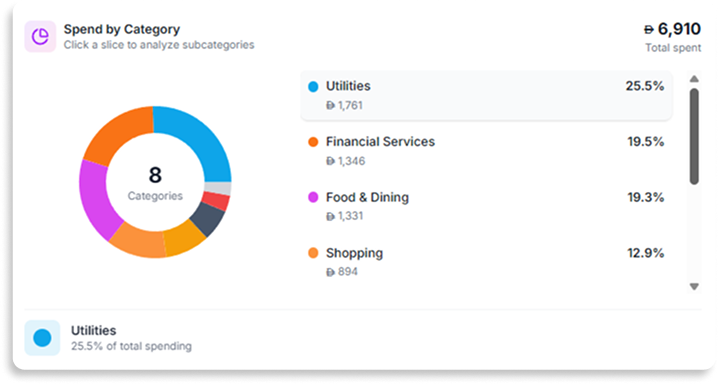
Upload bank statements and Clarvia categorises spending automatically, separating annual charges like a premium renewal from recurring monthly costs, so out-of-pocket medical spending can be seen as a single yearly figure rather than a scatter of individual transactions. For households whose mandatory policy excludes categories such as maternity or dental, that yearly figure is the number that makes the size of the gap concrete.
Start your free trial to organise your UAE financial information in one place, and see what a year of healthcare spending outside your policy has actually cost.