
The single most-asked retirement question is the simplest to phrase and the hardest to answer: how much do I need? For UAE expats, the question is harder than it would be for someone in a single-country career, because the answer depends on a variable most retirement calculators don't ask about: where the retirement will actually take place.
A UAE expat planning to remain in the UAE has a different cost base than one returning to the UK with a paid-off mortgage, who has a different cost base than one moving to Portugal, who has a different cost base than one returning home to Mumbai or Manila or Cairo. Each of those geographies has different healthcare costs, different housing costs, different currency exposures, and different tax regimes for the same dollar of retirement income.
This article is an educational walkthrough of how retirement planners typically structure the question, what UAE-specific factors come into the picture, and the structural variables that drive any individual answer. It is not retirement, financial, investment, pension, tax, legal, or immigration advice. Clarvia does not recommend a specific number, a withdrawal rate, a portfolio structure, a country to retire in, a visa pathway, or a time to stop working. Those decisions belong with appropriately licensed advisors working with the actual personal numbers.
The shape of the question, not the answer
There is no single right number for retirement. There is, however, a way the question is conventionally structured, which is the conceptual framework most professional advisors begin from before layering their own judgement on top.
The starting point is annual spending in retirement, not annual income. The two are not the same. Income tends to drop in retirement; spending tends to drop too, but unevenly, and the shape of that drop depends on housing, healthcare, family obligations, and lifestyle.
Some retirement-planning literature discusses income-replacement ratios, broad terminology that retirees may need a percentage of their pre-retirement income to maintain a comparable lifestyle. These ratios are background concepts only, not targets, and actual spending needs vary widely by individual. As U.S. News and others have noted, financial planners often observe that any single ratio is a poor fit for the early-versus-later-retirement spending shape that most retirees actually experience.
Once a target annual spending picture is sketched, retirement-planning literature often discusses historical studies, including the Trinity Study (Cooley, Hubbard, Walz 1998) and later research on portfolio withdrawals. These studies are useful background for understanding why annual spending, time horizon, inflation, market returns, and flexibility matter to retirement maths. They are not personal withdrawal-rate recommendations, they are not guarantees, and they should not be used to calculate a target retirement amount without licensed financial advice. Subsequent academic and practitioner work, including extensive coverage on Bogleheads and Retirement Researcher, has explored many refinements to the original methodology. None of these refinements changes the educational point: methodology informs the conversation; it does not replace the advisor.
Clarvia does not recommend a withdrawal rate, a portfolio structure, or a retirement amount.
Where you retire is the biggest variable
For a UAE expat, the second sentence of any retirement plan is usually "where am I retiring." That single variable changes everything downstream.
There are four common patterns:
Stay in the UAE. Some UAE residents may have retirement or long-term residency pathways available within the UAE, subject to age, financial, property, documentation, and other criteria that change over time and depend on individual circumstances. Clarvia does not provide immigration advice. The UAE Government's official portals, including the General Directorate of Residency and Foreigners Affairs (GDRFA) and the Federal Authority for Identity, Citizenship, Customs & Port Security (ICP), publish current criteria; a qualified immigration advisor can review any specific situation.
Return to the home country. For many UAE expats, retirement plans involve returning to the country of origin, often timed around children's education, parental care, or a paid-off home. The cost base resets to the home-country baseline, and home-country tax rules may apply to UAE-accumulated assets in ways that depend on nationality, residency, asset type, and timing. Returning home may create tax considerations for assets, income, and transfers that are best worked through with country-specific tax advice before any move or asset sale.
Retire in a third country. Some UAE expats consider retiring in a country that is neither their origin nor the UAE. Each jurisdiction has different residency, healthcare, tax, and cost-of-living implications, and qualified country-specific advice is the appropriate source for any of these choices.
Hybrid. Splitting time across two or more countries can raise complex tax-residency questions that require qualified cross-border tax advice. This is the most personalised pattern and the one where licensed cross-border tax expertise matters most.
The structural point is that the same currency figure on a nest egg can produce very different retirement outcomes depending on geography, currency, healthcare costs, tax treatment, and spending needs. The geography decision is not downstream of the money decision; it is upstream of it.
The variables that actually drive the answer
For any individual retirement scenario, the inputs that drive the actual answer are typically:
- Target annual spending, expressed in the currency of the chosen retirement geography
- Life expectancy and the planning horizon
- Healthcare costs, both insurance premiums and out-of-pocket exposure, which vary widely by country and by age
- Currency exposure between the assets and the future spending obligations (assets denominated in one currency funding spending in another are structurally different from a single-currency match)
- Inflation assumptions, which differ by country and by category
- Portfolio composition and its implied long-term return profile
- Withdrawal flexibility, including whether spending can flex down in poor market years; research discusses many withdrawal approaches, but their suitability depends on individual circumstances and should be assessed by a licensed advisor
- Sources outside the personal nest egg: existing state, employer, or workplace pension entitlements may be relevant inputs for a licensed advisor to consider, alongside end-of-service benefits, employer-provided workplace savings arrangements where applicable, property income, and similar
- Dependants: whether children, parents, or other family members rely on the retiree's income through retirement
Each of these inputs is a multi-page conversation in itself, and the interaction effects between them are where licensed financial planning earns its keep. A blog post can describe the inputs; only an advisor working with the actual numbers can solve for the appropriate answer.
Why UAE residency can be helpful in the accumulation phase
The UAE is generally known for having no federal personal income tax on salary and no general personal capital gains tax on investment gains. Individual tax obligations can still depend on nationality, residency, asset location, and the future destination country, but during the accumulation phase the absence of UAE-side personal tax can mean a structurally larger share of pre-retirement income is potentially available for saving and investing than in many higher-tax jurisdictions.
Whether any individual UAE resident is actually in a position to save more depends on housing costs, school fees, family obligations, and the quality of the household's spending discipline. The accumulation advantage is genuine, but it does not by itself change the retirement-side maths. The eventual question, "what spending will this picture support, in the country I'll be living in, with the tax regime that applies there," is the same question every retirement planner faces.
Common patterns worth knowing
Across UAE-expat retirement discussions, a few patterns recur:
- Lifestyle creep is the silent retirement-runway problem. Tax-free Dubai salaries that arrive without an explicit savings discipline tend to expand to fit the lifestyle they support. The household savings rate, more than any specific investment decision, often determines whether the long-term picture works.
- Currency thinking is hard. Earning in AED and planning in another currency requires a deliberate exchange-rate framework. The actual purchasing power of any given balance depends on the currency in which retirement spending will be denominated.
- Healthcare is often undercounted. Healthcare cost inflation tends to exceed general inflation in many destination retirement countries, and pre-existing-condition rules can affect insurability later in life.
- End-of-service benefits are one component, not the plan. UAE end-of-service gratuity is a meaningful lump sum but is generally a contribution to the overall picture rather than the picture itself. Workplace savings arrangements, where applicable, can play a similar role.
- Home-country entitlements still matter. Existing state, employer, or workplace pension entitlements in the home country may be relevant inputs for a licensed advisor to consider, even for expats who left the home country years ago.
Where Clarvia helps
Clarvia is not a retirement advisor and does not assess any individual's retirement readiness, suitable target amount, asset allocation, or withdrawal approach. Those are decisions for a licensed financial advisor, working with the actual personal numbers, in the context of the chosen retirement geography.
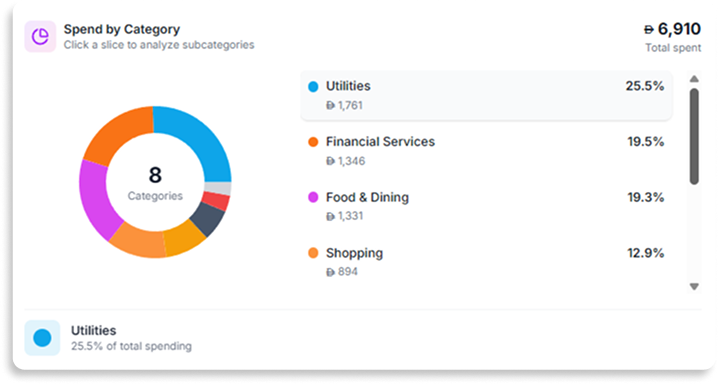
What Clarvia does is organise the inputs that any honest retirement conversation depends on. Upload UAE bank statements and payslips, and Clarvia categorises spending automatically, separates fixed monthly obligations from discretionary categories, and shows the household's actual savings rate over time. The retirement-planning conversation with a licensed advisor sits on top of those numbers, not on guesses about them.
Start your free trial to see your current spending, savings rate, and recurring obligations in one place, ahead of any conversation about long-term retirement planning.
Clarvia does not provide financial, investment, pension, tax, legal, or immigration advice. The information below is general education only and may not apply to individual circumstances.