
Few household financial conversations in Dubai recur as often as buy or rent. The case for buying tends to come up around every rent-renewal letter, every brunch with friends who recently bought, every off-plan launch hoarding on Sheikh Zayed Road. The case for renting tends to come up around every property listing that has moved up on last year, every conversation about service charges, every conversation about whether the next career move is in the same city or somewhere else.
There is no universally right answer. There are only individual answers, shaped by household income, time horizon, residency status, family plans, and risk appetite, and those are conversations for licensed mortgage brokers, property advisors, tax advisors, and where relevant immigration advisors. What this article does is set out the verifiable 2026 picture: what the latest market data from the Dubai Land Department actually says, what mortgage rules the UAE Central Bank has in place for expats, what the new RERA Smart Rental Index changes, and the structural inputs worth organising before that licensed-advisor conversation.
It does not contain a recommendation about whether to buy or to rent, or about whether 2026 is a good or bad year to do either. The aim is to organise the public data and budgeting inputs that households may want to discuss with appropriately licensed advisors.
The Dubai market in early 2026, by the DLD numbers
The Dubai Land Department publishes the authoritative transaction data, and Q1 2026 was a record-shaped quarter on most measures.
According to coverage of the Q1 release in Business Today Middle East, total real estate transaction value in Q1 2026 reached AED 252 billion, up 31% year-on-year, on 60,303 transactions, a 6% rise in volume. January 2026 alone set an all-time monthly record of AED 72.4 billion.
Citywide average price per square foot stood at AED 1,759 in Q1 2026, up 12.5% year-on-year. Within that headline:
- Apartments averaged AED 1,871 per sqft in March 2026, up 1.0% quarter-on-quarter.
- Villas averaged AED 2,376 per sqft, up 1.9% quarter-on-quarter, with resale-villa median prices reaching AED 4.3 million (+16.2% YoY).
- Off-plan transactions accounted for around 70% of volume and 71% of value.
The shape of the market that has emerged is one where the headline annual price appreciation is moderating from the 15%-plus surges of 2024 and 2025 to a 3-6% range in early 2026. Volume continues to rise, but the year-on-year gap between value growth (31%) and volume growth (6%) is consistent with a market where the average ticket size is climbing as the buyer mix shifts toward higher-value assets.
For live, neighbourhood-level price and transaction data, readers can consult DLD sources, including the DLD-affiliated DXBinteract platform, and compare them with other official or licensed sources.
Mortgages for expats: what the CBUAE rules actually say
Before any individual buy-or-rent comparison can be done, the structure of what financing is available is worth understanding. The UAE Central Bank publishes the rules in the CBUAE Rulebook, and the relevant figures for expat residents in 2026 are:
- For ready properties priced at AED 5 million or below, the maximum loan-to-value ratio for an expat resident is 80%, meaning a minimum 20% down payment.
- For ready properties priced above AED 5 million, the maximum LTV is 70%, meaning a minimum 30% down payment.
- For off-plan properties of any value, the maximum LTV is 50%, meaning a 50% down payment is required regardless.
- The maximum mortgage tenor is 25 years.
There are additional rules around debt-burden ratio and the borrower's age at maturity that vary by lender; those sit on top of the central LTV rules above.
Published market commentary in May 2026 reported indicative expat mortgage rates in the high-3% to low-4% range, with non-resident rates somewhat higher, varying by lender, borrower profile, property type, and package terms. These figures are illustrative only and are not mortgage advice or a product recommendation. The CBUAE base rate sat at 3.65% in the same period. For many households, the required upfront capital can be as important to the affordability picture as the quoted rate. A licensed mortgage advisor or lender should confirm affordability, debt-burden limits, and eligibility for any individual borrower.
The new RERA Smart Rental Index
On the rental side, the most consequential 2026 change is the launch of the Smart Rental Index by the Real Estate Regulatory Agency under the DLD. The change is structural: it moves Dubai's reference rental data from broad district averages toward property-specific benchmarking that reflects the building, the unit type, and the specific characteristics of the rental.
The legal rent-increase mechanics at renewal continue to follow a tiered system, where the cap depends on how far the current rent sits below the indexed market average for the specific property:
- Rent within 10% of the indexed average: no increase permitted at renewal
- Rent 11-20% below the average: maximum 5% increase
- Rent 21-30% below the average: maximum 10% increase
- Rent 31-40% below the average: maximum 15% increase
- Rent more than 40% below the average: maximum 20% increase
The Smart Index makes this calculation considerably more transparent than the previous district-level approach, and tenants and landlords can both check the indexed reference for any given property through the DLD's official tools.
Some property-data platforms also publish historical gross-yield estimates by area for landlord investors. These vary materially by building, unit, purchase price, vacancy, service charges, financing costs, and management fees, and historical figures are not guarantees of future performance. Clarvia does not assess rental yield, recommend investment areas, or advise on property selection. Yield-related decisions belong with a licensed property advisor.
Buy vs rent: the inputs that actually matter
The buy-or-rent comparison is often presented as a single calculation: rent for a year, multiply by some factor, compare to a mortgage. That misses most of what determines whether either choice works for any individual.
The structural inputs that tend to drive the answer are not financial-instrument inputs; they are circumstance inputs:
Time horizon. How long do you realistically expect to remain in Dubai, and in this specific property? Transaction costs (agent fees, DLD registration, mortgage processing, valuation, NOC, eventual exit fees) tend to be in the high single digits as a percentage of the purchase price, and they need to amortise across the period of ownership. Shorter holding periods can make those transaction costs more significant in any comparison; longer holding periods spread them across more years. The result depends on the specific numbers.
Residency and visa stability. Property ownership in Dubai is open to expats in designated freehold areas. Certain property ownership may be relevant to Golden Visa eligibility under the published rules, subject to the current criteria and official approval; readers should confirm with the relevant authority or a qualified immigration advisor for any specific case.
Down payment as opportunity cost. A 20% down payment on a AED 1.5M apartment is AED 300,000 of capital that is no longer available for other purposes. The relevant comparison is not just rent versus mortgage payment, but rent plus the return on that AED 300K invested differently, versus total ownership cost (mortgage payment plus service charges plus maintenance plus eventual exit costs).
Total cost of ownership versus total cost of renting. Owning a Dubai apartment means service charges, maintenance, building-improvement levies, and chiller costs in some buildings. Renting means an annual rent figure, possibly with multiple cheques, plus utilities. Comparing the two requires the full picture on each side, not just the headline figures.
Flexibility and risk appetite. Renting preserves optionality (career moves, family changes, neighbourhood changes); ownership reduces flexibility and introduces exposure to property-value movements, financing obligations, and ongoing ownership costs.
The honest framing is that the right choice depends on individual factors that a blog cannot evaluate. A licensed mortgage broker can model the financing side; a licensed property advisor can model the asset side; a tax advisor can model the home-country implications. The article you are reading helps with the inputs; the answers belong elsewhere.
Patterns worth being aware of in 2026
A few patterns that recur in UAE expat property discussions:
- Off-plan dominates volume and has a different risk profile from ready property. With off-plan accounting for around 70% of transactions in early 2026 and a 50% LTV cap from the CBUAE, the off-plan path is structurally different from buying ready property: handover risk, payment-plan complexity, and time-to-rental-income all sit differently and merit specific advice.
- Service charges are a commonly overlooked line item in ownership-cost comparisons. Service charges vary widely by building and amenities and should be checked against the official service-charge schedule for the specific property before committing.
- The Smart Rental Index changes the renewal conversation. Renewal disputes that were previously based on district averages now sit on more granular data. The published index for the specific property is the reference point for both sides.
- Mortgage pre-approval can materially affect the search process. Some buyers choose to compare indicative eligibility and costs with licensed lenders or mortgage brokers before viewing properties, because actual affordability can differ from rule-of-thumb assumptions.
- Exit costs deserve the same attention as entry costs. Mortgage early-settlement fees, agent fees on the resale, DLD transfer fees, and the time-on-market for the specific property type all matter for how the eventual exit will work.
Where Clarvia helps
Clarvia is not a property advisor, mortgage broker, or investment advisor. It does not assess affordability, suitability, mortgage eligibility, property value, or whether buying or renting is better in any individual case. What it provides is a clean view of the underlying cash flows.
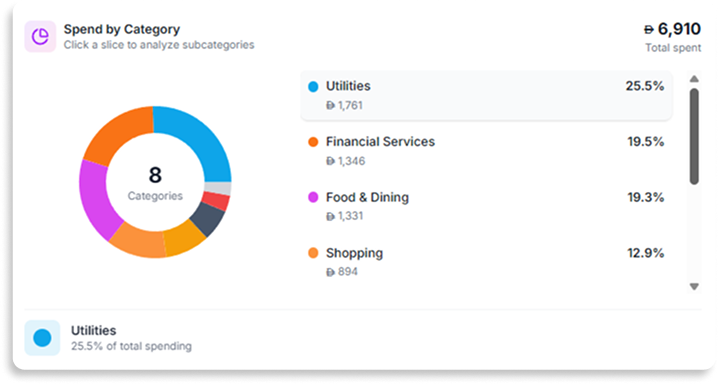
Upload bank statements and payslips, and Clarvia categorises housing-related costs (rent, DEWA, chiller, internet, agent fees, maintenance) so you can see what your current rented life actually costs in total. If you are considering an ownership scenario, the figures you receive from licensed advisors and official documents can be compared against your existing budget in a single view.
Start your free trial to understand your current housing cash-flow picture, which you may choose to share with licensed mortgage, property, tax, or legal advisors.